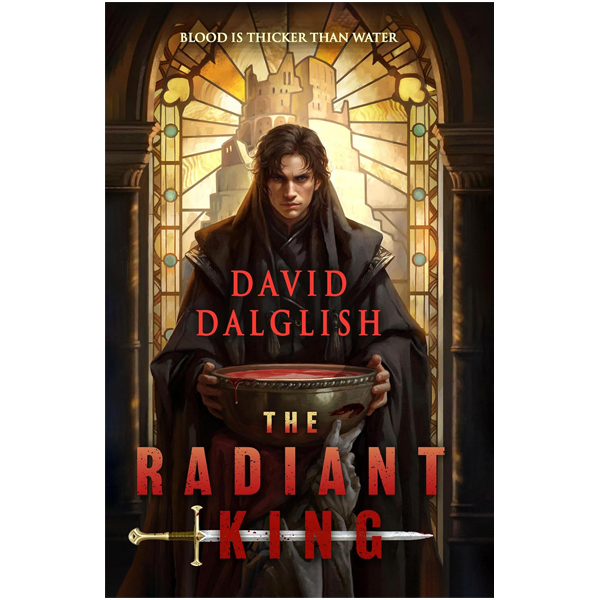
Author: David Dalglish (Astral Kingdoms Book 1)
Sometimes you open a book and within a few chapters you know you’ve found a story that isn’t just big, but mythic. That’s how The Radiant King felt to me: not simply another fantasy novel with immortals and magic, but an ambitious, brutal, and strangely tender exploration of what happens when gods are forced to live with the consequences of their own power.
The premise hooked me immediately. Six immortal siblings once wielded Radiance, a godlike force capable of shaping the world. After wreaking more damage than any kingdom could endure, they swore to stay apart from mortal politics and never rule. Of course, an oath like that only begs to be broken. When one of them, Eder, crowns himself “Voice of Father” and begins demanding obedience, his brothers and sisters must choose: hold to their sacred vows, or intervene to stop his tyranny. It’s the kind of set-up I adore, simple in concept but full of moral tangles, family drama, and divine fireworks.
What impressed me most was how weighty immortality felt here. These aren’t sleek, untouched demigods striding above humanity. They’re weary, scarred, often resentful, carrying centuries of grief and mistakes. I could feel that history pressing on them in every decision they made. There’s a constant sense of exhaustion underneath the grandeur, like even godhood corrodes under the endless passage of time. That paradox, powerful yet broken, gave the characters a texture I found deeply compelling.
Dalglish also paints his world with vivid, often horrifying imagery. Radiance isn’t some vague, glowy magic; it’s visceral. It can heal wounds in dazzling light, but it can just as easily twist flesh, resurrect bodies in grotesque ways, and burn through lives with terrible force. Some passages are downright grisly, and I admit I winced once or twice, but it worked. Magic should feel dangerous, not safe and sterile, and here it does.
Character-wise, I was pulled between fascination and frustration. Eder, the zealot brother, is terrifying because you can almost understand him. His conviction has a logic to it, a desperate clarity that makes his cruelty more unsettling. Then there’s Faron, who for me carried the emotional heart of the book—tragic, loyal, and haunted in a way that felt painfully human. Sariel, too, stood out as the sibling most aware of the long game, and I liked her sharp pragmatism.
If there was a weak spot for me, it was that at times the siblings slipped into archetypes: the brooder, the zealot, the schemer. They were well written, but I occasionally wished for a moment that shocked me, a crack in their personas that revealed something unexpected. I got glimpses of that, especially in their quieter conversations, but I craved a little more surprise from characters with infinite lifetimes behind them.
Pacing was the other sticking point. The book begins with a thrilling sense of urgency, drops into a slower middle where backstory and politics take over, and then roars to life again in the final act. I didn’t dislike the middle, it fleshed out the lore in satisfying ways, but there were evenings where I felt myself skimming, impatient to return to the main conflict. When the pace picked up again, though, I was reminded why I cared so much. The climax had all the grandeur, horror, and heartbreak I was hoping for.
What lingers most in my mind is the tone: a mixture of awe and melancholy. Dalglish doesn’t write this like a slick, quippy adventure; it’s heavy, atmospheric, often mournful. Immortality is lonely, and the book never lets you forget that. Even the most violent scenes are threaded with sorrow, as though every act of Radiance is both miracle and curse. That balance of beauty and brutality gave the story a resonance that stayed with me long after I closed the book.
So why 4.5 stars instead of a perfect 5? It comes down to momentum and depth. The slower sections lost me slightly, and I wanted a touch more unpredictability from certain characters. But those are quibbles against what is otherwise a fantastic, ambitious beginning to a new series.
The Radiant King delivers exactly what I look for in epic fantasy: grandeur without emptiness, violence with consequence, and characters who feel as weary and flawed as the world they’re trying to save. It’s bloody, it’s beautiful, and it’s brimming with ideas. I closed the book with that rare sense of having brushed against something vast, and I can’t wait to see how the rest of the Astral Kingdoms trilogy unfolds.
Final Verdict: A brutal, atmospheric, and emotionally charged fantasy that weds divine magic with very human grief. 4.5 shining, sorrow-stained stars. volume with eager, blood-warmed longing.